









The BRAVO Laboratory at the US Department of Veterans Affairs in the heart of New York City is making some moves — and that’s just how Cesar Jimenez, a 77-year-old Vietnam veteran and avid marathoner who lost his right leg below the knee from a machine-gun injury, likes it.
The North Plainfield, NJ, resident, who was born in Colombia and volunteered at 18 to join the service, is an active handcyclist and accomplished athlete, in large part thanks to the premier lab that’s become the gold standard in prosthetic care and research.
“I fish, I climb mountains, I do everything,” said the former ski instructor for the physically challenged who’s gamely tackled every curveball thrown his way. “It’s not a handicap — it’s just a challenge.”
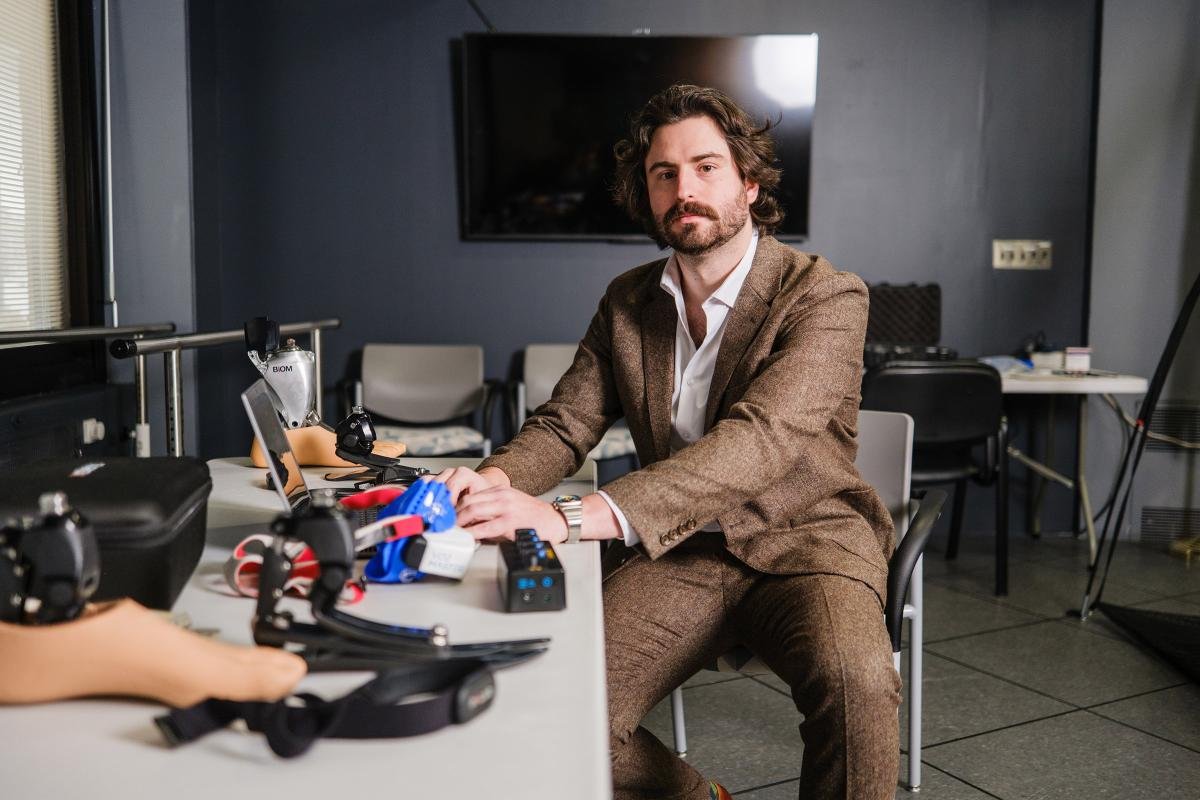
Touring the VISN2 BRAVO — Biomechanics Research for the Advancement of Veteran Outcomes — Lab evokes sci-fi mingled with technology and post-military miracles, as its signature 3D motion-capture system analyzes every angle of vets’ movements to help improve their quality of life.
Essentially built from scratch about 15 years ago, BRAVO, part of the VA New York Harbor Healthcare System, has become an elite research and clinical lab.
And Jimenez is a secret weapon in the Gait and Motion Analysis lab that allows researchers to study his movement to help assess veteran efficiency and mobility issues.
The lab’s seven-person team — including a research scientist, biomedical engineer, physical therapist, prosthetic technician, clinical coordinator and kinesiologist — focuses on high-level research and clinical care that help vets, many with vision and limb loss, tailor treatments, understand disability biomechanics and improve functional mobility.
The one-stop shop offers access to numerous procedures and rehabilitative devices while producing high-level research, mainly on the biomechanics of lower limb loss to evaluate how people move with different types of prosthetic and socket technology to advance imaging techniques.
3D motion capture records movement patterns to animate, analyze and describe those movements. It’s the same technology used in video games and movies, but instead of making animations, the lab wants to understand the biomechanics of how people move.
It happens as they walk, through golf analysis, cycling, running. And the “sky is the limit” as far as what can be analyzed, said the lab’s director, Jason Maikos, adding the lab is a tapestry of the finest elements: the best minds, the leading technology and the biggest hearts.
“This is probably the most unique lab in VA in the country,” said Maikos, noting that unlike the country’s other gait and motion labs, BRAVO is both a clinical and research service seeing some of the most complex cases around. “So not only are we an elite research team, but we provide this really specialized, unique care for veterans.”
The key technology enables the team to help maximize vets’ efficiency — how they walk and move — because, as Maikos puts it, “it’s such a vital part of their life.”
With multidisciplinary, complex cases, Maikos stressed the team has “a very objective view of how their body is moving and which ways we can improve it, either through technology, through physical rehabilitation or any number of different modalities.”
“Our prosthetic service probably provides the best limb loss care in the world, hands down,” he added; the lab sets itself apart with its access to the “latest and greatest technology.”
Since the team’s not beholden to Medicare, Medicaid or private insurance, if a device will be “medically advantageous or medically necessary for somebody, we don’t worry about how it’s going to be paid for or who can prescribe it.”
“If we feel like it’s going to help that particular veteran, we’re able to go through the necessary medical steps to make sure they get that care,” Maikos said proudly.
Research suggests it can cost over a million dollars over a lifetime of care for someone with lower limb loss. Not so with these vets. “They’re never gonna have to pay anything; they earned it.”
With some 1,700 traumatic amputations post 9/11, the lab sees no shortage of complicated cases.
One veteran is a skilled golfer. He’s also a double leg amputee and mostly blind from active duty.
Never count a vet out. “He’s an incredible golfer — it’s a passion, and he’s very active and motivated,” said Maikos. The 30-something had a golf consult with the lab. “So not only can he play with less pain, by analyzing his golf swing, he can also improve his mechanical swing.”
Some of the most cutting-edge research has been looking into underlying bone movement within prosthetic sockets. The lab uses dynamic stereo X-ray, a special technique that visualizes, tracks and then models the actual bone movement in a prosthetic socket.
The goal is to “help with optimizing prosthetic care in terms of the actual fittings and development of new prosthetics,” per John Chomack, a biomedical engineer who’s running a study with nearly two dozen veterans and civilians. “We’re hoping to keep using this and grow the technology so it could become a clinical care in the future so you can optimize the prosthetic fitting.”
The pioneering lab has scored $21 million in funding over the years — “from federal, industry and foundational sources,” said Chomack — for various studies, most of which look at lower limb loss.
Veterans will come in for a clinical consultation or for one of many ongoing research studies, where the team tries to better understand the vet’s gait and mobility and what asymmetries are occurring.
For those with a mobility device like a brace or assistive tech, the goal is to optimize it and analyze their motion with and without it.
“Maybe a different piece of technology we feel may help better their gait or mobility,” said Chomack, who’s been with the VA for a decade. “It’s part biomechanics but also subjective — we want to make sure that the patients feel safe but also feel that they have that confidence and the ability to do what they want to do.”
The lab sees vets from their 30s well into their 80s — spanning service in Vietnam and Korea to Iraq and Afghanistan — with trauma or an active-duty injury, striving to better their daily living or pursuit of adaptive sports or seeking running assessments or help with balance.
While some vets say they just want to be able to walk with their grandchildren, others want to run a marathon. They include a national handcycling champion and a professional wrestler who lost a leg post-9/11 during service and needed a highly specialized microprocessor knee that helps with stumble recovery.
The vets strive for a certain level of physicality. “Universally, what they all want is to feel like they have independence. They have their own ability to do what they need, but also what they want to do,” said Chomack.
Vets can have musculoskeletal and neurological injuries, like Parkinson’s, but there’s one common denominator: their sacrifice.
“There’s always a sense of pride, and it shows in how they carry themselves. They may not want to talk about exactly what happened during their service, but they have incredible pride that they did serve, that they’re part of this community and that they’re here, especially for research,” Chomack said.
He hears most frequently: “I’m helping you with your research so this research can help my fellow brothers.”
Maikos, the lab’s inaugural director who, with Jonathan Glasberg and others, transformed the space he inherited with a hodgepodge of old force plates 15 years ago, explained the plates’ significance.
Newton’s Third Law — for every action there’s a reaction — means every time someone steps on a plate, it pushes back up on the person. The team looks to see the forces that are going through the joints, which allows them to understand the forces that produce joint motion.
Eleven motion-capture cameras collect 360-degree views of joint angles and the amount of force people use as they walk around the lab, focusing on the 78 infrared markers attached to a vet’s body from head to toe.
The team collects the movement with the cameras at 120 frames per second, “a tremendous amount of data,” Maikos explained.
That lets the team analyze what those markers, arranged in specific locations — like joints, joint centers and body segments — are doing.
“We have a very comprehensive view of what those markers are doing and how the joints are moving,” he added.
Since X-rays don’t let you see the skin, the special radiopaque markers — small, visible indicators used in medical imaging — allow the team to view what the bone is doing on the X-rays and how the skin is behaving. It helps to evaluate any kind of skin strain as the person is walking in the lab.
And the biggest implication is on socket design — and the suspension methods for how the sockets are held onto the residual limb — and how it will affect that skin, which may not be built for load-bearing.
Once the markers are applied to the person, they’re translated in a 3D space digitally. The team can then connect the dots and create the model to analyze his golf swing, a favorite sport among vets.
BRAVO’s research uses commercially available technology so “people and researchers outside of the VA and federal settings can utilize these findings and apply them to their patient care or future research,” said Chomack, one of the foremost experts in dynamic stereo X-ray technology (DSX or optical-motion capture) who’s worked on some seven different research studies over the years at VA.
One is examining the biomechanical differences of those with low vision and blindness and adaptive sports’ effects on them.
A forthcoming prosthetic ankle-foot device study — considered one of the largest of its kind — will likely be published in the spring.
The application of some of the lab’s technology — such as DSX — isn’t widely known or used for prosthetic research and patient care, which is what sets BRAVO apart from most other research groups and helps with clinical implementation.
And that’s become a game-changer.
Its research trickles down to the private sector. For implantation, VA overall is piloting osseointegration surgery for veterans with transfemoral — above the knee — limb loss, which helps provide limb-loss care for those who have osseointegration.
3D printing, relatively new in health care, is a signature part of the lab — especially with its outstanding 3D printer. For vets without arms, the printer creates mouthpieces or adapters akin to video-game controllers. “So if a veteran doesn’t have use of one arm, we’re able to create a 3D-printed part custom for his controller that allows him to control it all with one hand,” said research engineer David Herlihy.
William Alvarez, an 80-year-old Manhattanite, is an avid marathoner who’s part of the Freedom Team for combat wounded veterans and Purple Heart recipients.
“I was young and handsome,” said the wistful army vet who’s a double below-the-knee amputee from a boobytrap in Vietnam.
“I got into a slump for a while but didn’t want to be a couch potato anymore.” He discovered adaptive sports through the lab and rows in regattas.
“They help me with posture, even with handcycling, and it helps me be more efficient with my stroke. I had special feet made for a fuller stroke, and I was able to use the oars better because the feet would flex,” he said, noting the ankle would bend back more naturally and could “fully participate.”
As for Jimenez, he can only partly blame BRAVO for helping him have the ability to comfortably shovel snow this winter and participate in his beloved Achilles Freedom Team for wounded vets.
Determined not to surrender to the injury like some fellow vets he’s seen deteriorate, Jimenez went on to climb mountains and become a ski instructor.
Aside from training for the upcoming Boston Marathon, he’s already planning to participate in the next study.
“It’s a tremendous help for the amputees,” he said, adding he’s spent time in the lab testing different feet to maximize balance. “They do really great work.”
Read the full article here