








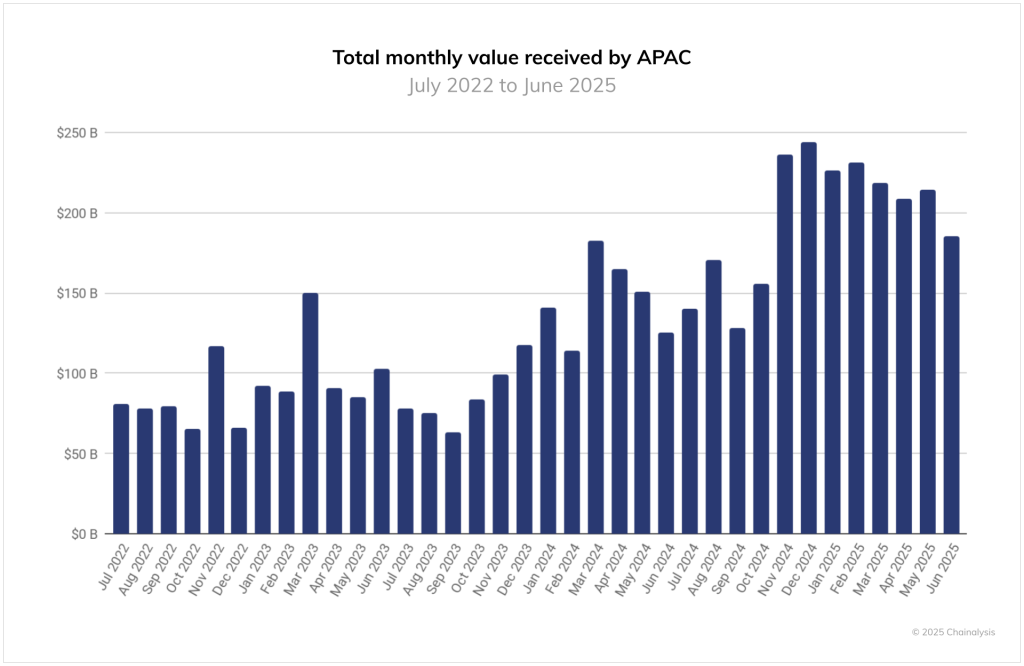
Across the world, financial institutions no longer need convincing that digital assets matter. The question now is where they can be deployed at institutional scale, with regulatory certainty and commercial viability. Asia-Pacific is increasingly an answer, mainly thanks to its early investment in clear licensing frameworks, compliance-first regulation, and infrastructure designed for long-term integration rather than short-term experimentation.
As we enter 2026, APAC has moved decisively beyond pilot programs. Institutional investors across the region are allocating at pace, with 71% now exposed to crypto, while governments and regulators are advancing frameworks that support real capital deployment: Hong Kong’s insurance regulator has proposed a legal framework enabling licensed insurers to allocate part of their balance sheets to crypto and related infrastructure, creating a formal pathway for billions in insurance capital to enter digital assets. Meanwhile, the broader digital asset ecosystem is growing rapidly, with the stablecoin market alone having hit roughly $280 billion and APAC driving significant growth in usage and transaction volumes across the region.
Banks are issuing tokenized bonds, and fintechs are embedding regulated custody and trading directly into products. This looks more like structural adoption than speculative momentum. APAC’s compliance-forward regimes are doing more than enabling innovation, they are creating the conditions for digital assets to function as a durable component of traditional finance, capable of supporting institutional capital at scale.
Principles-Based, Not Permissionless
The definition of being crypto-friendly has changed. It is no longer about policies that make it quicker, but rather about safe and secure adoption, with regulatory frameworks that last. And APAC is a prime example of how this shift is taking place as the integration of digital assets is being recalibrated.
Hong Kong exchanges soared to HKD 26.1 billion in the first half of 2025, a 233% year-on-year increase. What accelerates this growth is the issuance of nine new Virtual Asset Trading Platform (VATP) licenses, ultimately enabling a scalable regulatory foundation for digital asset trading. Banks such as HSBC and Standard Chartered are also investing in blockchain-enabled financial solutions.
Singapore is also leading the way through the Monetary Authority of Singapore (MAS) to ensure digital asset activities are conducted within a robust regulatory framework. The focus is not just on moving fast, but moving with secure guardrails in place that place them at the forefront of responsibly integrating digital asset adoption. It isn’t always who is the quickest or easiest, but rather who chooses to do so responsibly.
Additionally, through the financial services agency (FSA), Japan is taking the leap to bridge the gap between digital and traditional finance while addressing long-standing concerns about market integrity and compliance.
As APAC becomes the home to the world’s most engaged users, highest transaction volumes, and most forward-thinking regulators, it highlights how regulators have adopted the view that clarity does not mean compromise. APAC is actively working towards ensuring that the digital assets sector succeeds, but only while protecting consumers to achieve longevity.
Changes are happening, and while at first glance, these are looked at as roadblocks, in actuality, they are much-needed steps to work alongside the global trend of treating crypto as a legitimate asset class.
Accelerating with Confidence: Clear Frameworks and Controlled Innovation
One of the most powerful enablers of digital asset adoption in APAC is not because regulators are more lenient; they’re moving quickly because the rules are clear, structured, and forward-thinking.
APAC’s regulatory infrastructure allows internal compliance teams to align from day one, dramatically shortening the time between product strategy and execution. APAC-based institutions can go from ideation to launch in record time, while remaining fully audit-ready and aligned with regulatory expectations.
What strengthens this further is the region’s embrace of innovation-enabling tools like regulatory sandboxes and phased licensing rollouts. Singapore’s MAS trials give institutions a controlled, low-risk environment for experimentation. Likewise, Hong Kong and South Korea have adopted similar models, fostering proofs of concept.
Meanwhile, phased licensing regimes balance innovation with oversight. Transitional arrangements allow entities to operate while they work toward full compliance, offering predictability and regulatory cooperation that builds institutional trust.
These structured approaches signal that regulators in APAC aren’t just gatekeepers, they’re partners in progress. And for banks and fintechs looking to integrate digital asset infrastructure at scale, that collaboration is everything.
Lessons for the Global Stage
As debates rage in other parts of the world about how to regulate crypto, APAC offers a useful and practical blueprint. The focus does not lie on how to implement the perfect legislation, but rather the focus remains on clarity, adaptability, and safety, all upheld through compliance. And the result is clear, financial institutions are no longer watching from the sidelines, but they’re participating.
And participation matters. As the digital asset space matures, the winners won’t be those who move the fastest, but those who move with trust, resilience, and infrastructure that aligns with both technology and policy.
APAC Isn’t Waiting
The old perception of APAC as a “testbed” is outdated. This region is now a launchpad for digital asset innovation at scale, not in spite of regulation, but because of it. With transparent licensing frameworks, supportive sandbox environments, and proactive regulators, APAC is proving that compliance is not the cost of innovation, it’s the catalyst. As other markets continue to debate, APAC is building. And the institutions here aren’t asking “if” they’ll adopt digital assets, they’re asking how fast they can do it, how safely they can do it, and how long they can survive while succeeding. It’s a long-term game.
What sets APAC apart isn’t just its appetite for innovation. It’s the fact that regulators here are actively providing licensing pathways that make institutional adoption possible. APAC isn’t just testing digital assets. It’s operationalizing them.
Disclaimer: The views and opinions expressed in this article are those of the author and do not necessarily reflect the views of Cryptonews.com. This article is for informational purposes only and should not be construed as investment or financial advice.
The post How APAC’s Clear Licensing Frameworks Are Accelerating Institutional Digital Asset Adoption appeared first on Cryptonews.
Read the full article here