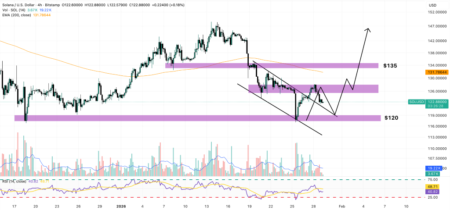













Shiba Inu is still under constant bearish pressure, and the chart structure does not provide much short-term rest for hopeful investors, and this kind of image is applicable for both $XRP and Bitcoin at this point in time. The asset is still trapped in a long-term downward trend, characterized by a series of lower highs and lower lows, and declining moving averages.
Shiba Inu enclosed
$SHIB is compressing inside a small triangular structure in recent price action. This formation is taking place within a larger bearish framework, rather than indicating a definite reversal. The prevailing trend is the main problem.
The long-term and medium-term moving averages are both far above the current price, and sloping downward. This alignment demonstrates that sellers maintain control over the structure of the market. Any brief uptick is quickly stopped by overhead resistance. This keeps momentum from developing into a long-term recovery.
The accumulation phase that is usually necessary before a significant trend shift is not being displayed by the market. This weakness is reinforced by volume behavior. Purchasing interest seems to be more reactive than proactive, with spikes mostly happening during relief rallies rather than gradual accumulation. This pattern implies that traders are taking advantage of volatility, instead of setting up for long-term gains.
$SHIB lacks the structural support necessary to end its larger bearish cycle in the absence of steady demand entering the market.
Technically, a quick breakout attempt could result from the small triangle that is forming close to recent lows. However, rather than serving as reversal signals, these patterns typically resolve as continuation setups during a dominant downtrend. Even if price pushes upward, multiple resistance layers remain stacked above.
Looking at things more broadly, there are not many indications that a proper recovery will occur anytime soon. Momentum indicators remain neutral to weak. Trend direction is negative, and price continues to respect bearish structure. The market has not yet produced the signals needed to support a bullish outlook for investors seeking confirmation of a turnaround.
$XRP cannot break through
As $XRP’s inability to recover the $2 level continues to impact price structure, it is once again moving toward a critical downside zone. With frequent rejections from important moving averages, the asset is trading inside a larger declining channel. This indicates bullish momentum has not been able to take control.
At this point, the chart increasingly suggests that a test of the $1.50 region is no longer a remote risk, but a plausible scenario.
The core of the current weakness is the failed attempt to break and hold above $2. $XRP approached that level with waning momentum, as it served as a psychological and technical barrier. The rally stalled under layered resistance created by the 26 and 50 EMA. It failed to build strength through higher lows and consistent volume.
By compressing price action and sloping downward, these moving averages are serving as a ceiling. Each rejection bolstered seller confidence. It also showed there was not enough demand to absorb supply near resistance.
The market structure deteriorated after the rejection. $XRP started printing lower highs again, signaling continuation of the downward trend. The recent recovery from local lows was shallow and corrective. It lacked the volume expansion usually associated with a reversal.
The lower boundary of the descending channel came under pressure as the price fell back under short-term support.
Momentum indicators show the same hesitation. $XRP is not significantly oversold, so buyers are unlikely to react aggressively. On trending markets, gradual declines are common when there are no strong oversold signals.
The chart reveals a relatively thin liquidity zone before the $1.50 area if current support fails. Long-term participants may attempt to defend prices there. It serves as the next major structural support.
Bitcoin bears lost it
The market structure clearly indicates that bears are still in control, and the recent price behavior of Bitcoin continues to favor sellers. Bitcoin has returned to a pattern of lower highs and feeble rebounds after failing to maintain recovery attempts above significant moving averages.
Each rally is swiftly followed by selling pressure, rather than follow-through buying. The chart depicts a market that is struggling to gain momentum.
The alignment of trend indicators is the most telling signal. The short- and midterm moving averages are above the current price and sloping downward. They serve as dynamic resistance. Bitcoin made a brief attempt to regain these levels and was rejected. This indicates bullish strength is still insufficient.
This repeated inability to hold above resistance discourages aggressive long positioning. It reinforces bearish dominance.
Although price action is contracting along an upward support line, this formation appears to be a pause rather than a true reversal base. Volume patterns suggest distribution rather than accumulation. Activity is stronger during sell-offs than during rebounds.
In strong recoveries, buyers absorb supply and push price past resistance. That behavior is not visible here. Instead, the market is drifting, with volatility favoring downside expansions.
Another downward leg is possible because momentum indicators remain neutral to weak. There are no strong oversold conditions forcing a bounce. In bearish environments, this often leads to grinding declines that gradually erode support.
Caution is the key takeaway for investors. Bitcoin is under bearish control but not collapsing. Rallies should be treated as corrective rather than trend-changing until the price reclaims key moving averages and establishes higher highs.
Read the full article here